Feeding advice across three babies — and learning how to filter the noise
Series Intro
Part 3 of the Newborn Seasons series — a look at how advice around feeding babies has changed over time, and why it can feel harder to find your footing now.
Previous: The Milk Foundation →
💬 Looking Back
When my first baby was born in 2010, feeding advice existed — but it was quieter.
There were guidelines, opinions, and emerging trends, but most early feeding decisions were shaped by a relatively small circle: a pediatrician, access to a lactation consultant when needed, a few trusted friends, and time. Advice didn’t demand certainty. It didn’t ask parents to pick sides.
With each baby since, the volume has increased — and so has the polarization.
Not because babies have changed, but because feeding advice has become louder, more extreme, and more confidently divided into “right” and “wrong.”
🧠 When Advice Turns Into Ideology
One of the biggest shifts isn’t in nutrition itself — it’s in how feeding advice is framed.
Today, guidance often arrives wrapped in language like:
ancient wisdom rediscovered what humans were meant to eat biologically optimal from the start
Bone broth as a first food.
Meat-forward feeding framed as evolutionary necessity.
Even literal meat bones being handed to babies to chew on as an introduction to eating.
Curiosity about nutrition isn’t new. What’s new is the certainty and urgency attached to these ideas — as if there is one correct way to feed a baby, and it must be followed immediately.
What often gets lost is context. Our ancestors lived in vastly different conditions — without modern medical care, food safety standards, or nutritional science. Many didn’t live long enough to pass down refined, population-level feeding practices. When pieces of the past are lifted without that reality, tradition can start to sound more authoritative than it actually is.

🧃 When Tools Become the Method
Baby food pouches were already common when my first two were little.
We used them — especially for travel. A few organic brands offered single-ingredient fruit options and separate vegetable options, and they were far easier to pack and carry than glass jars or multiple containers of homemade food.
But we treated them as baby food.
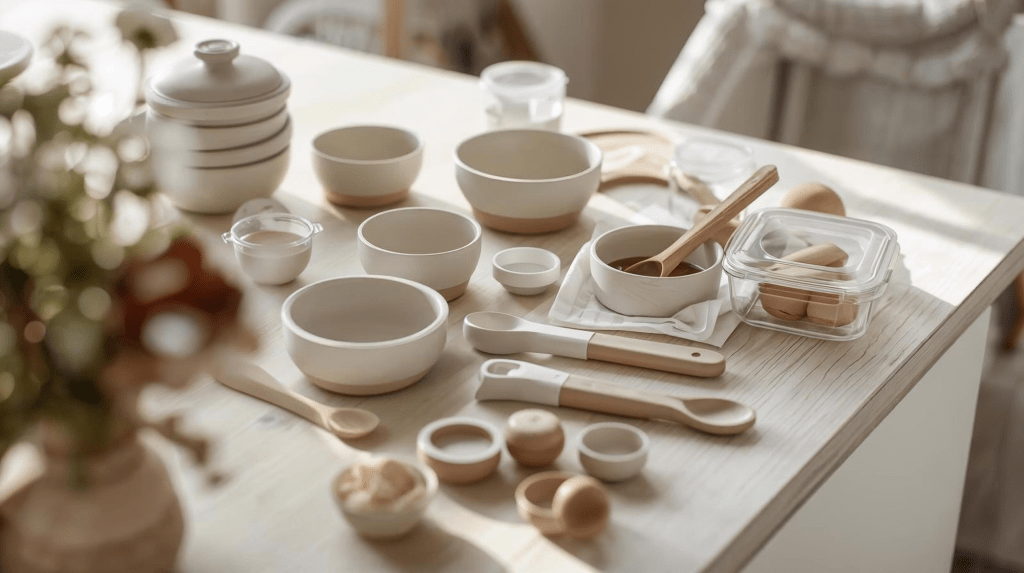
We used a spoon. We sat with our babies. They weren’t handed over as something to suck down on the go. The pouch was simply a less messy, more portable way to serve food we would have otherwise offered the same way.
Funny enough, years later we all still grab an applesauce pouch on the go.
What’s changed isn’t the existence of convenience foods. It’s how easily tools become the method when speed replaces intention.
💤 The Sleep Promise
Another belief that’s grown louder over time is the idea that starting solids earlier — often around two to three months — will lead to better sleep.
This isn’t a new hope. It echoes older practices where rice cereal was added to bottles at that age with the same goal: a fuller baby who sleeps longer.
The exhaustion behind that hope is real.
But feeding has never been a reliable solution for developmental sleep patterns. Night waking is part of infancy, and introducing food before a baby is ready doesn’t consistently change that reality. This is another place where urgency has crept into a process that still benefits most from patience.

🔄 What Actually Changed — and What Didn’t
Some feeding advice truly did evolve.
When my first two were babies, many families were advised to delay certain foods — especially those commonly associated with allergies — in the hope of preventing reactions. Over time, that guidance shifted as understanding improved. Earlier introduction of some foods became more common, while long-standing safety boundaries — like avoiding honey before one and respecting choking risks — remained unchanged.
One place where guidance has remained consistent is nutrition. As babies transition from milk to food, iron — along with other growth-supporting nutrients — becomes an important consideration, whether through foods, fortified options, or formula, depending on how a baby is fed. How families meet those needs can vary, but the principle itself hasn’t changed.
The advice changed — not because parents were doing it wrong before, but because knowledge grew.
What didn’t change is the baby.
Babies still:
learn to eat through exposure and repetition need time to explore texture and taste benefit from calm, responsive feeding
And parents still:
know their children better than any trend adapt based on real life, not headlines benefit from patience more than certainty
🌿 Finding Your Place in the Noise
What makes feeding feel harder now isn’t the food itself — it’s deciding what advice deserves space.
In a culture without deep, shared feeding traditions — and with voices pulled from many places — advice rushes in to fill the gaps. Some of it is thoughtful. Some of it is performative. Much of it is louder than it needs to be.
You don’t need to feed like an ancestor or a headline.
You don’t need to optimize every bite.
You don’t need to rush the process.
Feeding has always been about relationship first — and that hasn’t changed, even if the conversation around it has.

🪶 Author’s Note
If feeding feels more complicated than it used to, it’s not because you don’t have the right instincts. It’s because the noise has grown. The work now isn’t learning more — it’s learning what to tune out.

 This Wilderness Our Home
Leave a comment